410 Santa Maria, Irvine, CA 92606
E-mail us: [email protected]
24 Hour Service - 7 Days a Week

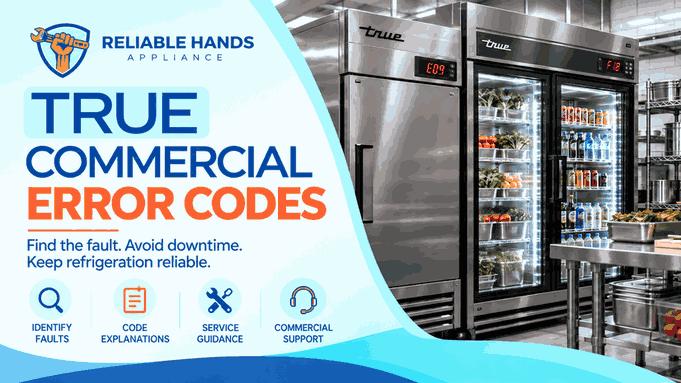
Understand True refrigeration error codes and controller alerts affecting commercial refrigerators, freezers, prep tables, merchandisers, and other cold-storage equipment.
Different cabinets may use Danfoss, LAE, ETC, or other controllers, and the same kitchen may contain two True units with completely different diagnostic systems.
True commercial refrigeration uses several electronic controller families across reach-ins, freezers, undercounters, prep tables, merchandisers, chef bases, worktops, scientific refrigeration, and other equipment.
There is no single universal True error-code list.
Different cabinets may use Danfoss, LAE, ETC, or other controllers, and the same kitchen may contain two True units with completely different diagnostic systems.
Always identify the model, controller family, and exact display message before interpreting an alarm.
Across several True controller families:
HI or hi means cabinet temperature has exceeded the configured high-temperature alarm threshold.
LO or Lo means the cabinet is below its low-temperature alarm threshold.
High cabinet temperature can be caused by open doors, heavy product loading, restricted airflow, condenser conditions, sensor faults, or refrigeration problems.
A low-temperature warning may involve control, sensor, or refrigeration conditions depending on the cabinet.
Commercial operators should compare the controller warning with actual product temperature when inventory condition is a concern.
dOr or do identifies an open-door alarm on supported True controllers.
A recurring warning with the door closed may require inspection of the door, gasket, switch, alignment, or controller input.
dEF means the appliance is currently operating in a defrost cycle.
This is normally a status message rather than a failure code.
Temporarily higher cabinet air temperature during normal defrost does not automatically mean refrigeration has failed.
True Danfoss ERC controls use:
E01 — Sensor S1 fault
E02 — Sensor S2 fault
E03 — Sensor S3 fault
E04 — Sensor S4 fault
An open, shorted, disconnected, or otherwise invalid sensor circuit may prevent accurate monitoring of cabinet, evaporator, or other operating temperatures.
The same controller family also uses:
EoC — communication problem between control and display
non — display sensor not configured correctly
SYn — connected display incompatible with the control
These are electronic or configuration problems rather than direct proof of a refrigeration failure.
Con is a condenser alarm on Danfoss-controlled True equipment.
Condenser cleanliness, airflow, and surrounding ambient conditions should be considered.
uHi indicates excessive incoming voltage.
uLi or uLo means incoming voltage is too low.
Persistent electrical-supply faults may interfere with compressor and control operation.
LEA is associated with extended compressor operation on applicable controls.
It is a refrigeration-related alarm, but it should not be treated as proof of a refrigerant leak without testing.
Long compressor runtime may also involve loading, doors, airflow, sensors, condenser conditions, or other refrigeration problems.
On applicable True ETC controls:
E4 means compressor fault.
E5 indicates a heater fault.
E13 identifies a communication error.
These codes belong to the ETC controller family and should not automatically be applied to equipment using Danfoss or LAE controls.
LAE-controlled True equipment uses a simpler probe numbering system.
E1 — Probe T1 failure
E2 — Probe T2 failure
E3 — Probe T3 failure
Loc means the keypad is locked.
Loc is therefore not evidence that the refrigeration system itself has failed.
Some LAE controllers can also display real-time probe readings and stored maximum or minimum temperature values, which may help when investigating a temperature complaint.
Current GDM and scientific merchandiser documentation can use:
do — door-open warning
hi — high cabinet temperature
Lo — low cabinet temperature
E1 through E3 — probe failures
Repeated customer door openings may temporarily increase refrigeration load on glass-door merchandisers.
If the cabinet cannot recover after normal use, airflow, doors, condenser condition, sensors, and refrigeration performance should be evaluated.
Before repair, record:
Equipment model
Serial number when available
Controller type
Exact display code
Current cabinet temperature
Product temperature when relevant
Door and loading conditions
Recent power or environmental changes
Do not replace sensors, controls, compressors, or refrigeration components based only on a generic True error-code list.
For professional True commercial refrigeration diagnostics and repair, contact Reliable Hands Appliance.
Phone: +1 (714) 338-9438
Email: [email protected]
Office Hours: Monday through Friday, 7:00 AM to 7:00 PM
Saturday: 9:00 AM to 6:00 PM
Sunday is reserved for emergency calls. Call to confirm availability.
Office: 410 Santa Maria, Irvine, CA 92606
Time Zone: Pacific Time