410 Santa Maria, Irvine, CA 92606
E-mail us: [email protected]
24 Hour Service - 7 Days a Week

Get professional AC diagnostics and repair for poor cooling, weak airflow, water leaks, frozen components, electrical faults, short cycling, and control problems.
AC repair involves diagnosing and correcting faults that prevent a cooling system from producing, distributing, or controlling conditioned air properly.
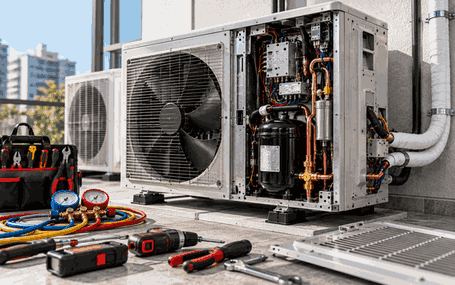
Reliable Hands Appliance provides air-conditioning diagnostics and repair for residential and qualifying commercial properties throughout Orange County, including Irvine, Costa Mesa, Newport Beach, Santa Ana, and Tustin.
Professional AC repair focuses on identifying and correcting faults that prevent an air-conditioning system from delivering sufficient cooling, maintaining airflow, or responding correctly to temperature controls.
Air conditioners rely on coordinated operation between indoor components, outdoor equipment, electrical systems, airflow pathways, and thermostats. Similar symptoms may originate from different parts of the system, making accurate diagnosis essential before replacing components.
Call (714) 338-9438 to discuss same-day or emergency AC repair availability. Appointment timing depends on technician coverage, system configuration, equipment access, diagnosis, and replacement-part requirements.
An air-conditioning system may continue operating while its cooling capacity, airflow, or electrical performance has already deteriorated.
Professional attention may be necessary when the AC system:
Runs but does not cool
Delivers warm or insufficiently cool air
Has weak airflow from several vents
Cools some rooms more effectively than others
Starts and stops repeatedly
Runs continuously without reaching the selected temperature
Does not respond to thermostat commands
Leaks water around indoor equipment
Develops ice on coils or refrigerant lines
Makes unusual grinding, buzzing, clicking, or rattling sounds
Produces burning or persistent musty odors
Trips an electrical breaker
Shuts down without warning
If your system is operating but failing to lower indoor temperatures, the article AC Not Cooling: Common Causes, Safe Checks, and What to Do Next explains potential reasons and appropriate preliminary observations.
A thermostat display that appears normal does not prove that the cooling system is functioning correctly. Similarly, an operating outdoor fan does not confirm that all components are delivering the required cooling performance.
Air-conditioning problems may involve airflow restrictions, failed electrical components, condensate drainage, temperature controls, refrigerant-system performance, or other equipment conditions.
Professional diagnosis helps determine which components are responsible for the reported malfunction.
Weak cooling and insufficient airflow may result from:
Clogged air filters
Malfunctioning blower motors
Restricted indoor coils
Blocked or damaged ductwork
Faulty zoning controls
Other airflow-related restrictions
A heavily loaded air filter can reduce the amount of air passing through the cooling system, affecting both cooling performance and heat transfer.
Some airflow problems also contribute to ice forming on the indoor evaporator coil.
However, visible ice does not automatically identify the cause. Electrical, airflow, or refrigerant-related problems may require additional testing.
Outdoor air-conditioning equipment contains components responsible for transferring heat and supporting the refrigeration cycle.
Cooling failures may involve:
Outdoor fan motors
Compressors
Capacitors
Contactors
Electrical relays
Control components
Wiring
Disconnects
Incoming electrical supply
A system may run its indoor blower without operating the outdoor cooling equipment correctly.
Electrical failures require appropriate professional testing. HVAC electrical compartments may contain hazardous voltage even when equipment appears inactive.
Occupants should not open electrical panels or attempt to replace capacitors, contactors, or internal wiring.
Water around indoor air-conditioning equipment may originate from:
Blocked condensate drain lines
Damaged drain pans
Thawing ice on a frozen coil
Condensation around insulated components
Other moisture-related conditions
Condensate problems can sometimes activate protective controls and cause an AC system to stop operating.
A visible puddle may not directly identify the source of the leak.
Stop using the equipment if water reaches electrical components or creates an immediate risk of property damage.
Insufficient cooling may require evaluation of the refrigeration circuit and its operating conditions.
Potential concerns include incorrect refrigerant charge, leaks, damaged components, and inadequate heat transfer.
Refrigerant is not normally consumed during standard air-conditioning operation.
Repeatedly adding refrigerant without identifying the underlying problem is not an appropriate substitute for diagnosis.
Availability for sealed-system or refrigerant-related work depends on the equipment configuration and repair requirements.
A few basic observations can help identify obvious operating conditions and provide useful information before the technician arrives.
First, confirm that the thermostat is in cooling mode and that the selected temperature is below the current indoor temperature.
Check whether the property is experiencing a general electrical outage.
If safely accessible, examine the air filter for visible restrictions.
Record the following information:
Thermostat temperature and settings
Displayed error messages
Approximate time the problem began
Whether indoor equipment is operating
Whether the outdoor unit is operating
Visible water or ice
Unusual noises
Unusual odors
If the thermostat screen is blank, the displayed temperature appears incorrect, or the HVAC system does not respond to commands, the guide Thermostat Not Working provides additional information about possible control and power problems.
When testing indicates that the thermostat itself is malfunctioning, professional thermostat repair may be necessary.
Avoid removing HVAC panels, bypassing safety switches, scraping ice from coils, or repeatedly resetting electrical breakers.
Turn off the affected equipment and seek qualified assistance if you observe:
Smoke
Electrical sparks
Exposed or damaged wiring
Strong burning odors
Water contacting electrical components
Contact emergency services when a situation presents an immediate electrical or fire hazard.
Reliable Hands Appliance evaluates repair requests for residential air-conditioning equipment and qualifying commercial cooling systems.
Residential repair requests may involve:
Central air-conditioning systems
Heat pumps operating in cooling mode
Ducted cooling systems
Thermostat and control equipment
Other commonly installed residential HVAC configurations
Equipment type, age, physical condition, installation arrangement, and accessibility help determine the appropriate diagnostic approach.
Commercial AC repair requests may involve qualifying light-commercial systems in offices, retail properties, managed buildings, and similar facilities.
Specialized rooftop units, larger-capacity systems, and complex commercial configurations require individual review to confirm service availability.
Commercial property contacts should provide:
Property type and intended use
Areas affected by cooling problems
HVAC equipment location
Business operating hours
On-site contact information
Roof or mechanical-room access requirements
Property-management procedures
Security restrictions
Providing access information before the visit can help determine whether the equipment can be inspected under safe and practical conditions.
A structured diagnostic process helps distinguish an isolated component failure from broader airflow, electrical, drainage, or refrigeration-system problems.
Provide the property address, type of cooling system, thermostat behavior, airflow concerns, visible water or ice, unusual sounds, odors, error messages, and available equipment information.
Explain whether the problem affects the entire property or only certain rooms.
The technician evaluates the applicable systems, which may include:
Thermostat and HVAC controls
Airflow
Accessible indoor components
Accessible outdoor components
Electrical operation
Condensate drainage
Cooling performance
The exact diagnostic process depends on equipment conditions and whether the system can be safely tested.
Testing should establish the cause of the failure before specific replacement components are recommended.
The technician explains the diagnostic findings and recommended repair scope before approved work begins.
Certain repairs can be completed when the appropriate components are available.
Other failures may require additional equipment access, specialized procedures, or model-specific replacement parts.
Following approved repair work, the affected equipment functions are checked when operating conditions permit.
Functional testing may involve relevant cooling response, airflow, electrical operation, condensate drainage, or thermostat commands.
Warranty terms for completed work and installed components should be confirmed in the repair documentation.
Repair may be practical when:
The malfunction is isolated
Compatible replacement parts remain available
The overall equipment condition is acceptable
The system has generally operated reliably
Corrective work can restore dependable cooling
Major or repeated component failures may justify evaluating whether replacement would better address the property's cooling requirements.
A professional AC installation assessment may be appropriate when essential components are obsolete, equipment is in poor condition, or the existing system no longer suits the property.
An air conditioner's age should not be the only factor influencing this decision.
Other considerations include:
Diagnostic findings
Previous repair history
Overall equipment condition
Cooling and comfort requirements
Replacement-part availability
Expected operational downtime
For a more detailed comparison, see Repair or Replace Your HVAC System.
Once an operating system has been repaired, regular AC maintenance can help identify developing airflow, drainage, electrical, and performance concerns.
Preventive care does not eliminate every future breakdown, but it helps distinguish planned system upkeep from repair of an active failure.
Possible causes include restricted airflow, dirty or frozen coils, failed fans, thermostat problems, electrical faults, compressor issues, or refrigerant-system conditions.
Professional testing helps identify the actual malfunction before repairs are recommended.
Frequent starting and stopping may involve:
Thermostat or control problems
Airflow restrictions
Electrical components
Equipment sizing
Temperature sensors
System protection devices
Persistent short cycling should be professionally diagnosed because repeated interruptions can place additional stress on equipment.
Commercial AC repair requests are accepted for review.
Provide the equipment type, approximate capacity, installation location, property use, and access requirements so service availability can be confirmed.
Same-day and emergency AC repair appointments may be available.
Availability depends on technician coverage, location, equipment type, access conditions, and replacement-part requirements.
Contact Reliable Hands Appliance with the property address, HVAC equipment type, cooling symptoms, error messages, equipment location, and access details.
Reliable Hands Appliance
Office: 410 Santa Maria, Irvine, CA 92606
Phone: +1 (714) 338-9438
Email: [email protected]
Hours: Monday-Friday, 7:00 AM-7:00 PM; Saturday, 9:00 AM-6:00 PM
Sunday: Emergency calls only; call to confirm availability
Time Zone: Pacific Time