410 Santa Maria, Irvine, CA 92606
E-mail us: [email protected]
24 Hour Service - 7 Days a Week

Professional heating repair for systems that fail to start, blow cool air, heat unevenly, cycle incorrectly, lose airflow, or develop electrical and control faults.
Heating repair involves diagnosing and correcting faults that prevent a system from generating, distributing, or controlling heat safely and consistently.
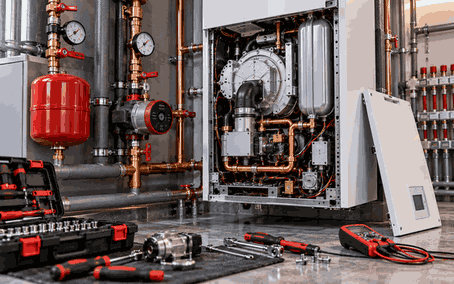
Reliable Hands Appliance provides professional heating system diagnostics and repair for homes, managed properties, offices, retail spaces, and other businesses throughout Orange County, including Irvine, Costa Mesa, Newport Beach, Santa Ana, and Tustin.
Heating system failures can involve thermostat settings, electrical supply, airflow restrictions, heating components, heat-pump controls, or equipment safety devices.
When a heater fails to start or cannot maintain the selected temperature, a complete diagnostic evaluation helps distinguish between control problems, internal equipment failures, and external operating conditions.
Call (714) 338-9438 to discuss same-day or emergency heating repair availability. Appointment timing depends on technician coverage, equipment type, property access, replacement-part availability, and the results of the diagnostic inspection.
Heating equipment may develop mechanical, electrical, airflow, or control problems before it stops operating completely.
Professional heating repair may be necessary when the system:
Does not start or produce heat
Blows cool or insufficiently warm air
Heats some rooms but not others
Has weak airflow throughout the property
Starts and stops repeatedly
Runs without reaching the thermostat setting
Shuts down unexpectedly
Makes new rattling, buzzing, grinding, or clicking sounds
Produces an unusual burning or fuel-like odor
Displays an error or warning
Trips a breaker or loses power
Does not respond correctly to thermostat commands
These symptoms can have different causes depending on the system's equipment configuration and energy source.
For additional guidance on common no-heat conditions, see Heater Not Working: Safe Checks, Common Causes, and Repair Signs.
A blower that continues running or a thermostat that displays the selected temperature does not necessarily indicate that the heating equipment is operating correctly.
Professional testing is necessary when ordinary operating checks do not explain the failure.
Heating equipment relies on several interconnected systems to produce and distribute warmth consistently.
Problems involving temperature controls, airflow, electrical connections, heating elements, and heat-pump operation can create similar symptoms.
Thermostats communicate heating requests to HVAC equipment through electrical or electronic control systems.
Incorrect settings, inaccurate temperature readings, wiring defects, failed relays, communication problems, or damaged controls can interrupt normal heating operation.
A thermostat may also lose power or stop responding when another HVAC component activates a safety device.
When a malf
Homeowners experiencing blank displays, unresponsive controls, or inconsistent temperature readings can review Thermostat Not Working for additional diagnostic information.
unction is isolated to the temperature control system, professional thermostat repair may be the appropriate solution.
A thermostat problem should be evaluated in relation to the entire heating system rather than assuming that the thermostat must be replaced.
Heating systems depend on adequate airflow to transfer warmth from the equipment into occupied spaces.
Restricted airflow may result from:
Dirty or restricted filters
Blower motor problems
Blocked return-air pathways
Duct restrictions
Damaged ductwork
Zoning control problems
Closed or obstructed supply registers
Airflow problems may cause uneven indoor temperatures, longer heating cycles, or protective equipment shutdowns.
A heavily restricted filter can also reduce system performance and contribute to overheating in certain heating configurations.
Professional diagnosis helps determine whether the problem originates in the heating equipment, blower assembly, controls, or air distribution system.
Electric heating equipment contains components responsible for heat production, fan operation, power distribution, and equipment safety.
Depending on the system, professional testing may involve:
Electric heating elements
Blower motors
Capacitors
Electrical switches
Relays
Wiring
Electronic control boards
Temperature protection components
Safety controls
A heating system may experience intermittent problems before a component fails completely.
Electrical faults can also cause unexpected shutdowns, repeated breaker trips, or loss of heating performance.
Heating equipment may contain hazardous electrical voltage even after normal operation stops.
Property occupants should not open electrical compartments or attempt internal repairs without appropriate qualifications.
Heat pumps can provide heating and cooling through coordinated refrigeration, airflow, and electronic control systems.
When operating in heating mode, faults may involve:
Thermostat and equipment controls
Airflow
Outdoor equipment
Defrost operation
Electrical components
Refrigeration-system performance
Temperature sensing
Certain changes in outdoor unit operation can be normal during a heat pump's defrost cycle.
However, persistent loss of heat, unusual icing, repeated shutdowns, or an inability to maintain indoor temperature may indicate a malfunction requiring professional testing.
The appropriate diagnosis depends on the system's operating mode, installed components, and actual performance.
Some heating-system conditions present risks that should be addressed before ordinary equipment diagnosis.
Stop operating the equipment when there is:
Smoke
Visible electrical arcing
Exposed or damaged wiring
A strong burning odor
Repeated electrical breaker trips
A persistent gas odor, suspected fuel leak, or carbon monoxide warning requires immediate safety action.
If gas is detected, avoid flames and electrical switches, leave the affected area, and contact the gas utility or appropriate emergency service from a safe location.
If a carbon monoxide alarm activates, leave the property immediately and follow the alarm manufacturer's emergency instructions.
Do not attempt to restart the heating equipment until the immediate safety concern has been addressed.
Fuel-burning equipment, electrical components, and safety devices require appropriate professional handling.
Heating repair availability for specialized systems must be confirmed using the equipment's specifications and installation conditions.
Reliable Hands Appliance evaluates repair requests involving residential heating systems and qualifying light-commercial equipment.
The applicable repair scope depends on equipment type, energy source, capacity, installation requirements, and accessibility.
Residential repair requests may involve:
Common residential heating systems
Heat pumps
Ducted heating equipment
Thermostats and temperature controls
Electric heating components
Other qualifying HVAC configurations
Different heating technologies require different testing procedures.
For example, a heating problem caused by a failed electrical component may resemble a control problem or restricted airflow.
Providing the equipment manufacturer, model information, and a detailed symptom description helps determine the appropriate diagnostic approach.
Qualifying light-commercial heating repair requests may be reviewed for offices, retail properties, managed buildings, and other business environments.
Equipment installed on rooftops or in restricted mechanical spaces may require additional planning.
Commercial property contacts should provide:
Building use
Areas affected by heating problems
Equipment location
Operating hours
On-site contact information
Roof or mechanical-room access
Property-management requirements
Security or access procedures
Specialized rooftop, fuel-burning, and larger-capacity equipment is evaluated individually before appointment availability is confirmed.
When heating, cooling, airflow, and several control functions are affected simultaneously, a broader HVAC repair assessment may be appropriate.
Heating repair should begin with identifying the actual source of the malfunction.
The diagnostic process helps distinguish an isolated component failure from a larger system problem.
Before requesting service, prepare the property address and available information about the heating equipment.
Describe:
System type
Energy source when known
Thermostat behavior
Displayed error codes
Unusual sounds or odors
Airflow changes
Approximate time the problem began
Report any immediate safety concerns before the technician arrives.
Providing accurate information helps the repair team evaluate access requirements and the reported symptoms.
During the diagnostic visit, the technician examines the systems associated with the reported failure.
Testing may involve:
Thermostat and controls
Airflow
Accessible heating components
Electrical systems
Equipment operation
Relevant safety functions
The diagnostic scope depends on the installed equipment and whether the system can be operated safely.
Testing should establish the source of the problem before replacement components are recommended.
After the evaluation, the technician explains the identified malfunction and the corrective work that may be required.
The repair recommendation may involve replacing a defective component, correcting an equipment-related problem, or identifying an issue outside the normal HVAC repair scope.
Some conditions may involve building utilities or systems maintained by another qualified provider.
Repair work proceeds after the applicable scope has been reviewed and authorized.
After the approved repair is completed, the affected heating functions are evaluated when operating conditions permit.
Functional testing may include system startup, thermostat response, heat delivery, airflow, or applicable controls.
Additional evaluation may be required when the system cannot be fully tested under the available conditions.
Warranty terms for completed repairs and installed components should be confirmed in the service documentation.
Professional heating repair may remain a practical option when:
The malfunction is isolated
Overall equipment condition remains serviceable
Compatible replacement components are available
Reliable heating operation can be restored
Equipment replacement may deserve consideration when:
Major failures occur repeatedly
Critical controls or components are obsolete
Structural damage is extensive
Replacement parts are unavailable
The existing system no longer meets the property's heating requirements
The decision should consider diagnostic findings, previous repairs, equipment condition, compatibility, operating performance, and the consequences of further downtime.
Equipment age alone does not determine whether replacement is necessary.
For a more detailed evaluation of these factors, review Repair or Replace Your HVAC System.
Once an active malfunction has been corrected, routine inspections can help identify new airflow restrictions, worn components, and changes in heating performance.
Professional heating maintenance focuses on planned equipment care rather than correcting an existing breakdown.
Maintenance requirements depend on the system type, operating conditions, manufacturer guidance, and previous performance.
The article How Often Should an HVAC System Be Serviced provides additional information about inspection intervals and system usage.
Preventive care cannot guarantee that future component failures will never occur, but it can help identify developing problems before they disrupt normal heating operation.
Possible causes include incorrect thermostat settings, heat-pump operating conditions, failed heating components, control faults, airflow restrictions, or external utility problems.
A running blower does not necessarily indicate that the equipment is producing sufficient heat.
Professional diagnosis is required when the problem persists.
Repeated shutdowns may involve:
Control problems
Restricted airflow
Electrical faults
Temperature protection devices
Equipment component failures
Heating systems may activate safety controls when operating conditions become abnormal.
Do not bypass protective devices in an attempt to keep the equipment running.
Commercial heating repair requests are accepted for evaluation.
Equipment type, capacity, energy source, installation location, access requirements, and property use determine whether the requested repair is supported.
Provide complete equipment details when contacting the team.
Same-day and emergency heating repair appointments may be available.
Availability depends on property location, technician coverage, equipment requirements, access conditions, and the nature of the malfunction.
Contact the team to confirm the available appointment options.
Contact Reliable Hands Appliance with the property address, heating equipment type, energy source, symptoms, displayed error codes, equipment location, and access information.
Reliable Hands Appliance
Office: 410 Santa Maria, Irvine, CA 92606
Phone: +1 (714) 338-9438
Email: [email protected]
Hours: Monday-Friday, 7:00 AM-7:00 PM; Saturday, 9:00 AM-6:00 PM
Sunday: Emergency calls only; call to confirm availability
Time Zone: Pacific Time