410 Santa Maria, Irvine, CA 92606
E-mail us: [email protected]
24 Hour Service - 7 Days a Week

Reliable Hands Appliance provides commercial freezer repair for temperature loss, frost buildup, airflow, defrost, drainage, electrical, and refrigeration system problems.
Reliable Hands Appliance provides professional commercial freezer repair and preventive maintenance for restaurants, bakeries, markets, hotels, cafes, commissaries, and managed facilities.
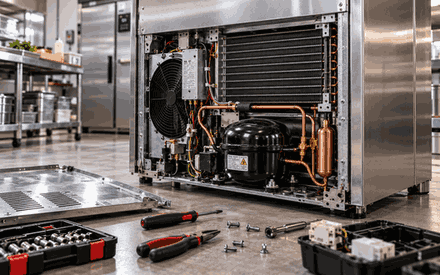
Reliable Hands Appliance provides professional commercial freezer repair and preventive maintenance for restaurants, bakeries, markets, hotels, cafes, commissaries, and managed facilities.
Repair is available for businesses throughout Orange County, including Irvine, Costa Mesa, Newport Beach, Santa Ana, and Tustin.
Commercial freezer repair addresses faults that interfere with low-temperature storage, airflow, defrost cycles, drainage, door sealing, electrical controls, and refrigeration performance.
A freezer can continue producing normal operating sounds even when its temperature is rising. Product temperatures, alarm records, and recent operating behavior are often more useful diagnostic indicators than compressor noise alone.
Businesses experiencing inadequate freezing can review the guide Why Is My Commercial Freezer Not Freezing for information about common faults and initial equipment checks.
Call (714) 338-9438 to request commercial freezer repair. Same-day and emergency appointment availability depends on location, technician coverage, site access, equipment condition, and replacement-part requirements.
Commercial freezers differ in cabinet construction, refrigeration configuration, controls, installation requirements, and operating conditions.
Repair requests may involve:
Reach-in freezers
Upright commercial freezers
Undercounter freezers
Worktop freezers
Commercial chest freezers
Glass-door merchandising freezers
Prep-line freezer sections
Chef-base freezer sections
Walk-in freezers
Freezers with remote condensing systems
Select professional-style freezers used in hospitality and managed properties
Walk-in and remote refrigeration equipment may have major components installed in different areas.
If possible, identify whether the condensing unit is indoors, outdoors, on the roof, or in a mechanical room. This information helps the repair team determine the equipment's accessibility before arriving.
Problems with commercial freezing equipment often affect stored products before the entire system stops operating.
Professional diagnosis may be necessary when a freezer:
Cannot maintain its selected temperature
Has unstable cabinet temperatures
Repeatedly activates temperature alarms
Operates continuously without reaching the setpoint
Starts and stops more frequently than normal
Recovers slowly after loading or door opening
Has uneven temperatures between storage sections
Develops excessive frost
Accumulates solid ice
Has weak evaporator airflow
Produces unusual fan noises
Possible causes include damaged door gaskets, obstructed airflow, malfunctioning fans, temperature sensors, electronic controls, defective defrost components, condenser restrictions, or sealed refrigeration-system problems.
Identifying the actual failure requires testing appropriate to the equipment rather than assuming that one symptom always points to the same component.
Reliable Hands Appliance also diagnoses commercial freezers experiencing:
Water collecting near the cabinet
Blocked drainage
Doors that fail to close securely
Damaged hinges
Worn or torn gaskets
Excessive vibration
Repeated clicking
Burning odors
Electrical breaker trips
Repeated ice removal without locating the underlying cause may conceal a defrost, drainage, ventilation, or door-sealing malfunction.
Stop operating equipment when continued use creates a safety concern.
Never open refrigerant lines or bypass electrical, pressure, or temperature protection devices.
Commercial freezers containing refrigerants such as R290 require handling by appropriately trained personnel.
When a freezer begins losing its ability to maintain the required temperature, the business should prioritize product protection while arranging equipment diagnosis.
Record the following information:
Displayed cabinet temperature
Independent thermometer readings when available
Alarm history
Approximate time the problem was discovered
Keep freezer doors closed whenever possible, except when products need to be transferred.
Follow the facility's established food-safety procedures and applicable health requirements when evaluating inventory condition, documenting temperature changes, and relocating stored products.
Move affected inventory to verified working cold storage when required.
Reliable Hands Appliance diagnoses the malfunctioning equipment. The business remains responsible for decisions about food safety and product disposition under its operating procedures and applicable requirements.
Reliable Hands Appliance accepts relevant commercial freezer repair requests involving Avantco, Beverage-Air, Hoshizaki, True, and Traulsen equipment.
Service availability depends on the specific model, configuration, physical condition, and compatible replacement-part availability.
When possible, provide photographs of the manufacturer data plate, model number, and serial number before the appointment.
References to equipment brands do not imply authorization or affiliation with their manufacturers.
Commercial freezer repair starts with gathering equipment information, understanding the reported symptoms, and identifying the systems involved in temperature regulation and refrigeration performance.
Provide the:
Business name
Repair address
Site contact
Unit identification
Brand
Model number
Serial number
Current temperature
Error code
Symptom timeline
Mention whether the freezer supports active production and whether inventory has already been transferred to another refrigeration system.
The technician may inspect accessible components associated with:
Temperature control
Airflow
Door sealing
Defrost operation
Drainage
Electrical operation
Condenser performance
Refrigeration-system performance
Testing is carried out only when the equipment can be operated safely.
After completing the diagnostic evaluation, the technician explains the findings, proposed repair, and any requirements for model-specific replacement components.
Commercial refrigeration systems vary considerably in design, so repair completion during the first appointment cannot always be guaranteed.
Commercial freezer maintenance involves planned inspections and care intended to reduce avoidable temperature interruptions and identify component wear before more serious equipment failures occur.
Businesses managing several appliances can use the Commercial Appliance Preventive Maintenance Checklist to organize equipment observations, maintenance records, and routine inspections.
Depending on the model and installation, preventive maintenance may involve examining:
Temperature response
Accessible condenser areas
Accessible evaporator areas
Fans
Door gaskets
Hinges
Drains
Electronic controls
Visible electrical connections
Unusual ice patterns
Abnormal noise
Employees should follow manufacturer cleaning recommendations and keep equipment clearances and ventilation openings unobstructed.
Preventive maintenance should account for each facility's operating requirements and be documented separately for each appliance.
An active temperature alarm, warming condition, water leak, excessive frost accumulation, or electrical malfunction requires professional diagnosis rather than routine maintenance alone.
Commercial freezer repair may be appropriate when the cabinet and doors remain structurally sound, the malfunction can be identified, compatible parts are obtainable, and reliable temperature performance can be restored.
Replacement may deserve consideration when:
Structural damage is severe
Refrigeration components are obsolete
Electronic control components are unsupported
Equipment failures occur repeatedly
Operational risk becomes difficult for the business to manage
Equipment age alone should not determine whether repair or replacement is appropriate.
The decision should also account for repair history, physical condition, required work, parts support, temperature recovery, and the potential effects of future downtime.
Possible causes include door leakage, frequent moisture entry, blocked drainage, restricted airflow, defective fans, or defrost-system problems.
The location and pattern of frost can provide diagnostic clues, but they do not establish which component has failed.
Yes. Repair requests are accepted for walk-in freezers and systems with remote condensing equipment.
Provide access instructions and model details for both the evaporator and condensing unit when available.
No. An alarm may indicate a genuine cooling, airflow, door, defrost, loading, or temperature-sensor problem.
The current cabinet temperature and equipment performance should be evaluated before resetting or replacing electronic controls.
Yes. Maintenance can be arranged for an individual commercial freezer or multiple supported units at the same business location.
Provide an equipment list and relevant site information so the maintenance work can be planned around the facility's requirements.
Contact Reliable Hands Appliance with the service address, site contact, equipment type, brand, model, serial number, current temperature, error code, and access details.
Reliable Hands Appliance
Office: 410 Santa Maria, Irvine, CA 92606
Phone: +1 (714) 338-9438
Email: [email protected]
Hours: Monday-Friday, 7:00 AM-7:00 PM; Saturday, 9:00 AM-6:00 PM
Sunday: Emergency calls only; call to confirm availability
Time Zone: Pacific Time