410 Santa Maria, Irvine, CA 92606
E-mail us: [email protected]
24 Hour Service - 7 Days a Week

Decode common Hoshizaki error codes and alarms for commercial ice machines, dispensers, refrigerators, freezers, and food-service refrigeration systems.
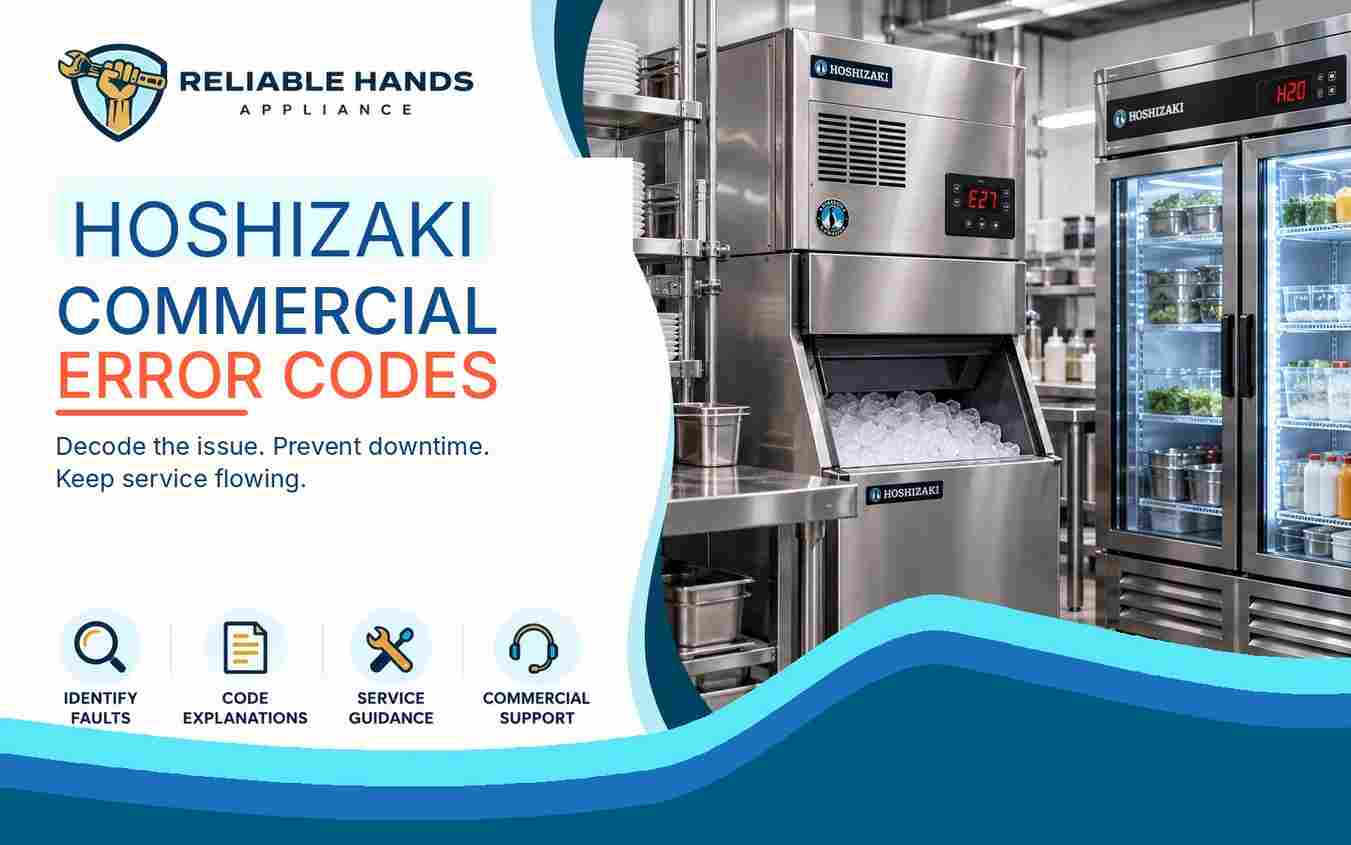
Hoshizaki commercial equipment includes multiple product families, from modular ice cubers and flakers to dispensers, prep tables, equipment stands, and reach-in refrigeration.
Hoshizaki commercial equipment includes multiple product families, from modular ice cubers and flakers to dispensers, prep tables, equipment stands, and reach-in refrigeration.
Their diagnostic systems are equally varied. Some Hoshizaki units display letter-and-number error codes, while others communicate protective shutdowns through repeating beep patterns.
A code used on an IM cuber should not automatically be applied to a KM machine, flaker, or reach-in refrigerator. Always identify the exact model family and complete fault indication before interpreting the problem.
On applicable IM-Series ice machines:
E1 indicates a freeze-cycle error. The machine exceeded its freeze backup timing without completing the expected cycle.
E2 means the harvest cycle did not finish within the allowed time.
EE (E3) indicates that the water-tank assembly did not open correctly.
EE (E4) means the water-tank assembly did not close correctly.
Other documented IM warnings include:
EE (E5) — excessive evaporator temperature
EE (E7) — locked fan motor
EE (E8) — pump-motor lock
EE (EA) — control data or memory problem
EE (EC) — open or shorted evaporator thermistor
These faults can reduce production or shut the ice machine down completely.
KM modular cubers commonly use repeating beep sequences rather than conventional display codes.
1 beep every three seconds indicates excessive evaporator temperature.
2 beeps means the harvest or defrost backup timer has expired.
3 beeps means the freeze cycle has exceeded its maximum permitted time.
Long freeze or harvest cycles may involve water-system conditions, thermistor problems, valves, refrigeration performance, or other operating faults.
6 beeps indicates low control voltage.
7 beeps identifies excessive voltage.
These warnings demonstrate why electrical supply should be considered before assuming every KM shutdown involves the refrigeration system.
Flaker and cubelet machines use another protection system.
1 beep means a low-water safety condition.
3 beeps indicates that the high-pressure switch has operated.
On applicable equipment, 4 beeps indicates a fourth high-pressure event. Hoshizaki recommends leaving the machine off until the problem is resolved.
5 beeps represents a freeze-timer fault.
6 beeps indicates low voltage.
7 beeps means high voltage.
8 beeps may involve gear-motor protection and, on certain cubelet models, an evaporator thermistor condition.
9 beeps concerns the backup bin-control circuit on supported modular machines.
Repeated high-pressure or motor-protection alarms should not simply be cleared and ignored.
SteelHeart prep tables and equipment stands use conventional electronic display warnings.
E01 indicates a cabinet thermistor malfunction.
E02 identifies a defrost-thermistor fault.
Hi means cabinet temperature has remained above the permitted level for an extended period.
Lo means cabinet temperature has remained too low.
UHi and ULo indicate high- and low-voltage conditions. The controller may interrupt compressor operation when voltage moves outside its protection range.
For persistent temperature alarms, actual product temperature should be checked as part of the business's food-handling procedures.
Current RR/RF reach-in refrigeration uses another prioritized alarm system.
E1 — high-temperature alarm
E2 — low-temperature alarm
E3 — defrost alarm
E4 — repeated high-pressure condition
E7 — condenser filter requires attention
E8 — defrost-thermistor malfunction
E9 — clogged-filter thermistor fault
EA — EEPROM write error
ED — EEPROM verification or read error
These meanings belong to the applicable reach-in family and should not be transferred to Hoshizaki ice-machine platforms.
Record the model number, complete code or exact beep count, and the stage in which the problem occurs.
For ice machines, note whether the failure occurs during fill, freeze, harvest, or bin control. For refrigeration equipment, record cabinet and product temperatures.
Avoid repeatedly clearing protection alarms involving high pressure, excessive temperature, voltage, or motor protection. These safeguards may be stopping operation for a reason that requires testing.
For professional Hoshizaki commercial ice machine and refrigeration repair, contact Reliable Hands Appliance.
Phone: +1 (714) 338-9438
Email: [email protected]
Office Hours: Monday through Friday, 7:00 AM to 7:00 PM
Saturday: 9:00 AM to 6:00 PM
Sunday is reserved for emergency calls. Call to confirm availability.
Office: 410 Santa Maria, Irvine, CA 92606
Time Zone: Pacific Time