410 Santa Maria, Irvine, CA 92606
E-mail us: [email protected]
24 Hour Service - 7 Days a Week

AC installation tailored to your property, airflow, controls, electrical conditions, equipment placement, accessibility, and long-term cooling needs.
AC installation is a site-specific project that matches cooling equipment and required work to the property's comfort needs, existing HVAC system, airflow, controls, electrical conditions, equipment placement, and access.
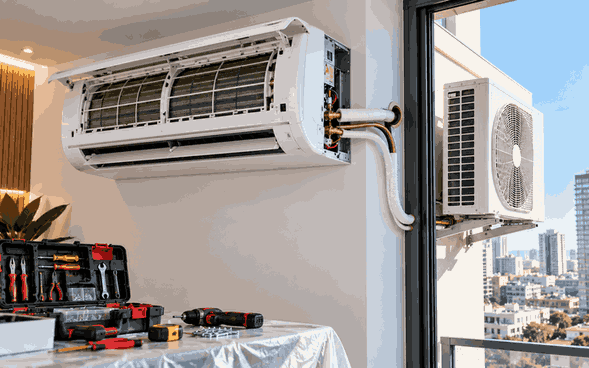
Reliable Hands Appliance provides professional air conditioning installation assessments and AC installation for residential properties, managed buildings, offices, retail locations, and qualifying commercial spaces throughout Orange County, including Irvine, Costa Mesa, Newport Beach, Santa Ana, and Tustin.
Selecting new cooling equipment requires more than choosing a familiar manufacturer or matching the capacity printed on an existing unit. The appropriate system depends on property conditions, comfort needs, airflow, electrical requirements, controls, installation space, and the compatibility of existing components.
A professional assessment helps establish the necessary installation work before equipment and project details are finalized.
Call (714) 338-9438 with your property address, existing cooling arrangement, and installation requirements. Project availability and the final installation scope depend on the equipment, site conditions, and assessment findings.
A new air conditioning installation may be appropriate when an existing system cannot provide suitable cooling, important components are obsolete, or the property's requirements have changed.
Consider requesting an installation assessment when:
The property has no suitable cooling equipment
An existing system has experienced repeated major failures
Essential replacement components are no longer supported
Cooling performance is consistently inadequate
Renovation has changed the building layout
New occupancy conditions have altered cooling requirements
Existing system controls no longer meet the property's needs
Equipment placement or configuration presents ongoing operational problems
Replacing an air conditioner should follow an evaluation of the equipment's actual condition.
A cooling problem does not necessarily mean that a new installation is required. When the system is malfunctioning but its overall condition has not been established, professional AC repair may be the appropriate first step.
Property owners comparing the two options can also review Repair or Replace Your HVAC System for guidance on equipment condition, recurring failures, compatibility, and system performance.
An installation decision should be based on documented needs rather than an isolated symptom.
A dependable AC installation assessment considers the property as a complete cooling environment.
Equipment capacity is important, but airflow, building characteristics, controls, available space, and supporting infrastructure can determine whether the proposed installation will operate correctly.
An installation assessment may consider:
Areas requiring conditioned air
Building size and layout
Property occupancy
Sun exposure and surrounding conditions
Existing air distribution
Comfort differences between rooms
Cooling performance during normal operation
Property usage patterns
Business or occupancy hours
A property with different heating loads, occupancy patterns, or ventilation conditions may require a different cooling approach from another building of similar size.
Commercial property owners should identify heat-producing equipment, affected work areas, tenant needs, and operating restrictions.
If the existing unit is running but cannot adequately cool the property, the guide AC Not Cooling provides additional context about faults that can resemble inadequate equipment capacity.
Existing systems and infrastructure can influence the installation plan.
The assessment may review:
Indoor HVAC equipment
Outdoor cooling equipment
Ductwork and airflow pathways
Thermostat wiring
Electrical service and connections
Condensate drainage
Equipment pads and mounting areas
Refrigerant line routing
Access for future service
Some existing components may be suitable for continued use, while others may need replacement or modification.
Compatibility and condition should be confirmed before equipment is retained as part of a new installation.
The location of indoor and outdoor equipment affects installation work, equipment delivery, noise considerations, maintenance access, and future service.
Relevant installation areas may include:
Attics
Closets
Side yards
Balconies
Rooftops
Mechanical rooms
Gated communities
Restricted equipment spaces
Access arrangements should be considered early in the project, particularly when equipment must be moved through narrow spaces or installed in locations with limited clearance.
Installation planning should maintain safe and practical access to the completed system.
The selected cooling system must operate correctly with its thermostat and control configuration.
Conventional air conditioning, heat pumps, multi-stage systems, zoning arrangements, and communicating equipment can have different control requirements.
Existing thermostats may not support every function of new cooling equipment.
The condition and suitability of thermostat wiring, controls, and communication features should be assessed before the system is approved.
When a thermostat has existing power, sensing, or communication problems, professional thermostat repair may also be relevant to the overall HVAC evaluation.
Reliable Hands Appliance reviews requests involving residential cooling installations, replacement projects, and qualifying commercial HVAC configurations.
Residential projects may include:
Central air conditioning systems
Compatible split-system equipment
Replacement of existing cooling systems
Supported heat-pump configurations
Cooling installations associated with property improvements
The recommended equipment and required work depend on the property's existing systems, cooling requirements, and installation conditions.
Commercial installation requests may involve offices, retail spaces, managed properties, and qualifying light-commercial cooling equipment.
Commercial project review may require information about:
Equipment capacity
Property use
Areas requiring cooling
Equipment location
Roof or mechanical-room access
Electrical infrastructure
Tenant coordination
Business operating hours
Specialty systems, large-capacity equipment, and rooftop installations require individual evaluation to confirm whether the project is within the available service scope.
No single air conditioning brand or model is suitable for every installation.
Equipment selection should account for:
Required cooling performance
System configuration
Existing HVAC compatibility
Physical installation space
Equipment serviceability
Air distribution conditions
Available electrical infrastructure
Current equipment availability
The objective is to identify equipment that matches the property's actual requirements rather than selecting a system solely by brand preference.
A structured installation process helps establish the equipment requirements, supporting work, and functional testing needed for a completed cooling system.
Provide information about:
Property address
Building or property type
Rooms or zones requiring cooling
Current HVAC equipment
Existing performance problems
Desired installation outcome
Access restrictions
This initial information helps clarify whether the project involves adding new cooling equipment, replacing an existing system, or modifying the property's current arrangement.
The technician reviews relevant property conditions, including mechanical equipment, electrical connections, airflow, controls, drainage, physical placement, and accessibility.
The assessment may identify supporting work needed before installation can proceed.
Tasks outside the normal HVAC installation scope may require coordination with appropriately qualified contractors.
The proposed system is selected in accordance with the assessment findings.
Installation planning should identify:
Major cooling equipment
Existing components suitable for reuse
Thermostat and control requirements
Equipment placement
Necessary supporting work
Installation access and coordination requirements
The proposed scope should be explained and approved before installation begins.
Approved installation work is performed according to the confirmed configuration.
Following installation, applicable startup, airflow, drainage, thermostat, control, and cooling-operation checks help verify that the equipment responds as intended.
Testing requirements vary according to the installed system and operating conditions.
After the installation, the property owner or designated contact should receive information about normal system use and available equipment documentation.
Relevant control settings, operating procedures, and warranty terms should be reviewed for the selected equipment.
Continued performance also depends on proper use and preventive care. The AC maintenance page explains the role of routine inspections and equipment reviews after installation.
Preparing the property helps technicians evaluate equipment locations, existing infrastructure, and installation access.
Where applicable, provide safe access to:
Existing indoor and outdoor HVAC equipment
Thermostat controls
Electrical service areas
Potential equipment locations
Attics
Rooftops
Mechanical rooms
Parking and delivery areas
For commercial properties, additional information may be needed about:
On-site contacts
Property management procedures
Tenant coordination
Security requirements
Insurance requirements
Permitted work hours
Equipment delivery restrictions
Avoid purchasing equipment before system compatibility, installation requirements, and project scope have been evaluated.
A replacement unit with a capacity rating similar to the old system may still be unsuitable because of different electrical, control, installation, or equipment requirements.
Cooling equipment should be selected based on the building's characteristics and actual cooling requirements.
Floor area is only one consideration. Building layout, sun exposure, occupancy, existing airflow, insulation conditions, and HVAC configuration may also affect the selection.
Professional evaluation helps determine the appropriate equipment and installation approach.
An existing thermostat may be reused when its wiring, operating functions, and communication requirements are compatible with the selected cooling equipment.
Compatibility should be confirmed before installation is approved.
Commercial air conditioning installation requests can be evaluated.
Availability depends on equipment type, capacity, installation requirements, property access, and the final project scope.
Yes. New air conditioning systems still require appropriate maintenance according to manufacturer guidance, equipment design, operating hours, and property conditions.
For a broader explanation of service intervals and preventive system care, see How Often Should an HVAC System Be Serviced.
Regular attention can help identify developing airflow, drainage, electrical, and operating concerns before they become more serious.
Contact Reliable Hands Appliance with your property address, current HVAC equipment, installation objective, equipment location, and access information.
Reliable Hands Appliance
Office: 410 Santa Maria, Irvine, CA 92606
Phone: +1 (714) 338-9438
Email: [email protected]
Hours: Monday-Friday, 7:00 AM-7:00 PM; Saturday, 9:00 AM-6:00 PM
Sunday: Emergency calls only; call to confirm availability
Time Zone: Pacific Time