410 Santa Maria, Irvine, CA 92606
E-mail us: [email protected]
24 Hour Service - 7 Days a Week

Professional commercial oven repair for heating, temperature regulation, convection airflow, ignition, door, and control problems in gas and electric equipment.
Reliable Hands Appliance provides professional commercial oven repair and preventive maintenance for restaurants, bakeries, cafes, catering kitchens, hotels, commissaries, bars with food service, and other managed commercial kitchens.
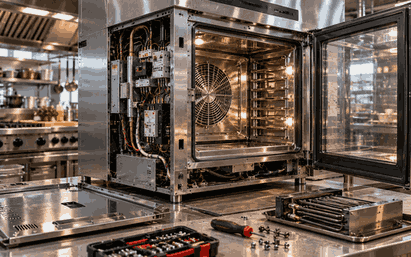
Reliable Hands Appliance diagnoses and repairs gas and electric commercial ovens used in professional kitchens, hospitality facilities, and managed commercial properties.
Service is available throughout Orange County, including Irvine, Costa Mesa, Newport Beach, Santa Ana, and Tustin.
Professional commercial oven repair addresses faults affecting preheating, temperature stability, heat distribution, convection airflow, ignition systems, door operation, and electronic controls.
In a busy kitchen, inconsistent heating can disrupt preparation times, food quality, and daily production. A unit may continue operating while struggling to recover temperature or deliver uniform heat across cooking racks.
Call (714) 338-9438 to discuss commercial oven repair. Same-day or emergency availability depends on equipment type, location, safe site access, technician availability, and replacement-part requirements.
Commercial cooking equipment varies considerably in size, heating technology, ventilation, control systems, and intended workload.
Repair requests may involve:
Commercial convection ovens
Countertop convection ovens
Standard commercial ovens
Bakery ovens
Deck ovens
Pizza ovens
Ovens integrated into commercial ranges
Electric wall ovens used in hospitality settings
Professional-style ovens used in managed properties
Gas ovens
Electric ovens
Dual-fuel cooking equipment
Some specialized ovens require additional consideration because of their ventilation arrangements, fuel connections, electrical systems, or safety interlocks.
Providing the equipment specifications, model number, and installation details helps determine whether the requested repair is supported.
Consistent temperature control is essential for baking, roasting, and other production tasks. Heating problems may affect startup, preheating, recovery between batches, or individual cooking functions.
Professional evaluation may be appropriate when an oven:
Does not start or begin heating
Takes unusually long to preheat
Does not reach the selected temperature
Operates hotter than expected
Operates below the required temperature
Produces uneven baking or roasting results
Loses heat during production
Has an inoperative heating element
Has a burner that fails to ignite
Shuts down unexpectedly
Repeatedly displays temperature or control faults
These symptoms may involve heating elements, burners, gas igniters, valves, temperature sensors, thermostats, control boards, relays, convection fans, door components, wiring, or utility connections.
Businesses experiencing these symptoms can review Why Is My Commercial Oven Not Heating Properly for an explanation of common causes and preliminary observations.
Accurate diagnosis considers the entire operating cycle, rather than relying exclusively on a displayed temperature or assuming that a heating component has failed.
Commercial oven repair may also be needed for:
Noisy or stationary convection fans
Doors that do not close securely
Worn or damaged door seals
Damaged hinges
Unresponsive electronic controls
Intermittent ignition
Continuous clicking
Electrical odors
Abnormal burner flames
Recurring error codes
A worn door gasket or defective convection fan can reduce heating consistency even when the heating system itself remains operational.
An oven that heats uncontrollably, produces electrical sparks, develops smoke from an electrical compartment, or smells of gas should not remain in service.
If a gas leak is suspected, avoid operating switches or introducing ignition sources. Leave the affected area and follow the property's emergency procedures or contact the gas utility from a safe location.
Reliable Hands Appliance accepts commercial oven repair requests involving Avantco, ZLINE, Wolf, and Signature Kitchen Suite equipment.
Avantco cooking appliances are commonly found in food-service environments. Other listed manufacturers may be represented in hospitality kitchens, demonstration facilities, amenity spaces, and professionally managed properties.
Repair availability depends on the specific model, equipment configuration, installation conditions, site accessibility, and replacement-part availability.
Provide the complete model and serial number when requesting service.
Brand references describe equipment that may be evaluated for repair and do not indicate manufacturer authorization or affiliation.
Commercial oven repair supports a variety of professional cooking environments, including restaurants, bakeries, cafés, catering businesses, hotels, commissaries, institutional kitchens, and hospitality facilities.
Businesses operating both ovens and surface-cooking equipment may also require commercial stove repair for burner, rangetop, ignition, or cooktop problems.
When multiple cooking appliances are installed at one location, identify the affected oven and its exact position within the kitchen.
Provide relevant site information such as:
Service and delivery entrances
Parking conditions
Security requirements
Kitchen shutdown periods
Hood access
Restricted operating hours
Equipment-access limitations
The equipment must be accessible and sufficiently cool for safe inspection when the technician arrives.
A professional oven repair visit begins with collecting equipment information and identifying which cooking functions are affected.
Before the appointment, prepare the following:
Brand
Model number
Serial number
Gas or electric configuration
Error code
Selected cooking temperature
Observed temperature
Approximate preheat time
Affected cooking mode
Also explain whether the problem occurs on every rack, during particular cooking functions, or only after repeated production cycles.
These details can help identify whether the problem involves temperature sensing, ignition, convection airflow, heating components, or electronic controls.
Depending on the equipment and symptoms, the technician may inspect and test:
Heating components
Gas ignition components
Temperature sensors
Convection fans
Door components
Electrical systems
Electronic controls
Testing is performed only when the surrounding conditions, equipment accessibility, ventilation, and utility connections allow safe operation.
The diagnostic process helps distinguish internal appliance faults from operating conditions or external utility problems that can produce similar symptoms.
Once the problem has been identified, the technician explains the findings, recommended corrective work, and any requirements for model-specific replacement parts.
If the malfunction originates from building electrical infrastructure, gas supply, ventilation equipment, or fire-suppression systems, additional work may need to be handled by the appropriate qualified provider.
Commercial oven maintenance involves planned inspections and operating checks intended to identify developing problems before they interrupt kitchen production.
Businesses managing multiple cooking appliances can consult the Commercial Appliance Preventive Maintenance Checklist for additional guidance on equipment monitoring and routine maintenance.
Depending on the specific oven, professional maintenance may include reviewing:
Door components
Electronic controls
Temperature sensors
Convection fans
Gas burners
Heating elements
Visible wiring
Ignition performance
Temperature response
Cleaning procedures should follow manufacturer recommendations. Excessive moisture, unsuitable chemicals, and blocked ventilation can damage components or affect operating conditions.
Kitchen staff should record noticeable changes in preheat time, heat recovery, temperature consistency, and cooking performance.
Preventive maintenance cannot replace professional diagnosis when a commercial oven develops an active ignition failure, uncontrolled heating, electrical damage, a gas odor, or persistent control faults.
Commercial oven repair may remain practical when the cooking cavity, cabinet, and structural components are in acceptable condition and the failure can be corrected with available replacement parts.
Replacement may deserve consideration when:
Structural damage is extensive
Electronic controls are obsolete
Major failures occur repeatedly
Critical replacement components are unavailable
Extended equipment downtime creates unacceptable operational disruption
Equipment age is only one factor in the decision.
Business owners should also consider the oven's operating history, production requirements, ventilation compatibility, model configuration, availability of replacement components, and potential interruption to kitchen operations.
Professional diagnosis provides useful evidence for evaluating whether the existing oven can return to reliable service.
Uneven cooking may result from defective heating components, burner problems, poor convection airflow, inaccurate sensors, faulty controls, door heat loss, loading practices, or insufficient preheating.
Professional testing helps determine whether the problem originates within the equipment or from operating conditions.
Some commercial ovens allow temperature calibration or adjustment.
However, a substantial or inconsistent difference between selected and actual temperature may indicate a defective sensor, heating component, or control system.
The oven should be tested before calibration to avoid masking an underlying fault.
Yes. Repair requests are accepted for supported gas, electric, and selected dual-fuel commercial ovens.
Provide the model number, fuel type, and installation details so equipment coverage can be confirmed.
Yes. Preventive maintenance may be arranged for several supported commercial ovens or other appliances at the same business location.
Provide a list of equipment, relevant operating conditions, and site-access requirements so the work can be planned appropriately.
Contact Reliable Hands Appliance with the business address, site contact, appliance brand, model and serial number, fuel type, error code, temperature problem, and equipment-access details.
Reliable Hands Appliance
Office: 410 Santa Maria, Irvine, CA 92606
Phone: +1 (714) 338-9438
Email: [email protected]
Hours: Monday-Friday, 7:00 AM-7:00 PM; Saturday, 9:00 AM-6:00 PM
Sunday: Emergency calls only; call to confirm availability
Time Zone: Pacific Time