410 Santa Maria, Irvine, CA 92606
E-mail us: [email protected]
24 Hour Service - 7 Days a Week

Professional commercial stove and cooktop repair for gas burner, ignition, electric heating, induction, control, wiring, and safety-related equipment problems.
Reliable Hands Appliance provides professional commercial stove, range, and cooktop repair and preventive maintenance for restaurants, cafes, catering kitchens, hotels, bars with food service, commissaries, and managed commercial facilities
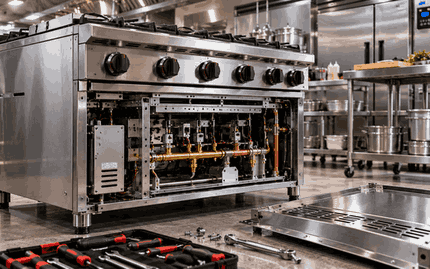
Reliable Hands Appliance diagnoses commercial gas, electric, and supported induction cooking equipment, helping businesses address failed burners, inconsistent heat, ignition problems, electrical faults, and unresponsive controls.
Service is available throughout Orange County, including Irvine, Costa Mesa, Newport Beach, Santa Ana, and Tustin.
Commercial stove repair focuses on surface-cooking systems, including gas burners, ignition assemblies, electric heating elements, induction modules, switches, wiring, and safety controls.
For equipment problems involving an enclosed baking or roasting compartment rather than surface cooking, see our commercial oven repair page.
Call (714) 338-9438 to discuss your equipment problem and appointment availability. Emergency and same-day requests are assessed according to technician coverage, equipment conditions, required parts, and safe property access.
Professional kitchens use different cooking systems depending on production requirements, available utilities, ventilation, and equipment layout.
Repair requests may involve:
Commercial gas ranges
Open-burner stovetops
Electric ranges
Commercial hot plates
Countertop gas ranges
Countertop induction units
Professional-style rangetops
Professional-style cooktops
Integrated commercial ranges with surface-cooking problems
Different appliances require different approaches to diagnosing heat production and control failures.
Specialized equipment such as griddles, charbroilers, fryers, or salamanders may need additional evaluation to confirm whether the specific model is supported.
Providing the manufacturer, complete model number, heating source, and equipment configuration helps determine repair availability.
Gas-operated cooking equipment depends on coordinated fuel delivery, ignition, burner condition, and heat regulation.
A fault in any of these areas may disrupt a single cooking station or affect multiple burners.
Professional attention may be appropriate when:
A burner fails to ignite
Ignition components click repeatedly
The flame goes out during cooking
Flame strength changes unexpectedly
Burner flames are irregular
Ignition is delayed
A burner takes multiple attempts to light
Temperature adjustment does not work correctly
The equipment activates a safety shutdown
An error message appears
Potential causes include worn ignition components, incorrectly positioned burner assemblies, residue accumulation, damaged switches, faulty valves, electronic controls, wiring defects, or building-side fuel-supply problems.
Technicians must distinguish between an equipment malfunction and external operating conditions before recommending replacement parts.
Do not enlarge burner openings, modify gas valves, disconnect safety devices, or attempt adjustments without qualified personnel and manufacturer-specific procedures.
A persistent gas odor, delayed ignition, or abnormal flame behavior can signal a condition that requires immediate attention.
If gas is detected, stop using the equipment, avoid operating electrical switches, leave the affected area, and follow the facility's emergency procedures or contact the gas utility from a safe location.
Do not repeatedly attempt ignition when a burner is behaving abnormally.
Professional evaluation should establish whether the problem involves ignition components, burner conditions, fuel delivery, or safety controls before the stove returns to normal operation.
Electric and induction cooktops rely on suitable electrical supply, heating components, electronic controls, and temperature-management systems.
Individual cooking zones may fail while the rest of the equipment continues operating.
Professional repair may be needed when:
A cooking zone produces no heat
A burner remains at a single power level
Heat output fluctuates unexpectedly
An induction surface does not detect suitable cookware
An error code appears
The appliance trips a circuit breaker
Electronic controls do not respond
Heating stops intermittently during operation
Faults may involve heating elements, induction modules, sensors, relays, switches, wiring, control boards, power supply, or internal cooling components.
Induction-related symptoms should be evaluated alongside cookware compatibility and appliance operating requirements.
Electrical problems should be investigated rather than repeatedly resetting breakers or restarting the equipment.
Stop using cooking equipment that produces sparks, burning odors, uncontrolled heat, or repeated electrical interruptions. A damaged or cracked cooking surface should also be inspected before further use.
Reliable Hands Appliance accepts relevant commercial cooking equipment repair requests involving Avantco, ZLINE, Wolf, and Signature Kitchen Suite appliances.
Avantco equipment is frequently used in professional food-service environments, while compatible Wolf cooking equipment may be found in commercial kitchens and hospitality facilities.
ZLINE and Signature Kitchen Suite models may also be installed in managed residential properties, shared amenity kitchens, demonstration environments, and hospitality settings.
Repair coverage depends on the equipment model, installation type, fuel or electrical configuration, physical condition, and compatible replacement-part availability.
Provide the complete model and serial number when contacting the service team.
Brand references identify manufacturers whose compatible appliances may be considered for repair. They do not imply authorization or affiliation with the equipment manufacturer.
Commercial stove and range repair supports restaurants, cafés, catering operations, commissaries, hotels, institutional kitchens, clubhouses, and managed hospitality properties.
Cooking equipment is often installed close to adjacent appliances, underneath ventilation hoods, or within integrated production lines.
These arrangements can affect inspection access and the ability to isolate the affected equipment.
Before the technician arrives, provide:
Business name and complete address
On-site kitchen contact
Equipment position
Parking or loading instructions
Property security requirements
Suitable service windows
Ventilation hood configuration
Equipment access limitations
Mention whether the cooking appliance shares a line with other equipment or requires coordination with kitchen personnel.
The affected equipment should be cool enough for safe inspection and accessible at the agreed appointment time.
Commercial stove repair begins with a clear description of the affected burner or cooking zone and a review of the equipment's operating conditions.
Useful information includes:
Manufacturer
Complete model number
Serial number
Gas, electric, or induction configuration
Displayed fault message
Affected burner or heating zone
Description of the operating failure
Explain whether the problem developed suddenly, occurs intermittently, or appeared after cleaning, installation work, or other changes.
For gas appliances, report ignition and flame behavior without attempting internal adjustments.
Depending on the appliance configuration and reported fault, the technician may evaluate:
Burner components
Heating elements
Ignition assemblies
Control switches
Temperature sensors
Electronic controls
Wiring and connections
Safety devices
Relevant electrical and utility conditions may also need to be considered when several pieces of cooking equipment experience similar failures.
Testing should follow appropriate procedures for the equipment type and be performed only when the appliance can be operated safely.
After identifying the probable source of the malfunction, the technician explains the findings and the recommended corrective work.
Some problems can be resolved with available components. Others require specialized or model-specific parts.
When diagnosis indicates an issue involving building utilities, ventilation, electrical infrastructure, or fire-suppression equipment, the property may need assistance from a separate qualified specialist.
Regular commercial stove maintenance helps identify developing burner problems, ignition faults, worn switches, visible electrical damage, and changes in heating performance.
Businesses maintaining several appliances can consult the Commercial Appliance Preventive Maintenance Checklist for broader guidance on equipment inspections and documenting operating conditions.
Depending on the appliance, a professional maintenance evaluation may include:
Accessible burner components
Ignition performance
Electric heating elements
Electronic controls
Operating switches
Visible wiring
Signs of excessive heat
Spill-related component deterioration
Kitchen staff should follow manufacturer-directed cleaning procedures and avoid damaging ignition electrodes, burner openings, controls, and electrical assemblies.
Excessive moisture or inappropriate tools may cause additional faults during cleaning.
Preventive maintenance supports reliable cooking equipment operation but cannot replace diagnosis when active hazards are present.
Gas odors, uncontrolled heating, electrical damage, cracked cooking surfaces, and repeated breaker trips require immediate attention.
Repair may be practical when the commercial stove's main structure and cooking surface remain in serviceable condition and the malfunction can be corrected using compatible replacement parts.
Replacement may become necessary when:
Corrosion affects major structural areas
Heat damage is extensive
Electronic controls are no longer supported
Ignition problems recur despite appropriate repairs
Electrical failures repeatedly interrupt operation
Existing equipment no longer meets kitchen operating requirements
Replacement planning should also account for gas or electrical connections, ventilation compatibility, appliance clearances, and applicable equipment requirements.
A new stove may not resolve a problem originating from the building's utilities or ventilation system.
Professional diagnosis can help distinguish a repairable appliance failure from a wider installation or infrastructure concern.
Continuous clicking may involve moisture, grease or spill residue, burner misalignment, defective ignition switches, wiring damage, or electronic-control faults.
If the burner continues clicking or cannot ignite reliably, stop using the affected cooking zone and request professional inspection.
Uneven flames may result from incorrectly positioned burner components, obstructed ports, component damage, or gas-supply conditions.
Delayed ignition, abnormal flame appearance, or a gas odor should be treated as potential safety concerns rather than ordinary cooking-performance problems.
Repair requests are accepted for compatible commercial induction appliances.
Provide the model number, fault code when available, and details about whether the problem affects one cooking area or the entire unit.
Commercial stove repair focuses on surface burners, cooktops, rangetops, heating zones, and associated controls.
Commercial oven repair focuses on the enclosed cooking compartment, including baking and roasting functions, temperature regulation, preheating, and convection airflow.
These systems may share a housing in some ranges but require different diagnostic procedures.
Contact Reliable Hands Appliance with the business address, site contact, appliance brand, model and serial number, utility type, affected burner or heating zone, error message, and access instructions.
Reliable Hands Appliance
Office: 410 Santa Maria, Irvine, CA 92606
Phone: +1 (714) 338-9438
Email: [email protected]
Hours: Monday-Friday, 7:00 AM-7:00 PM; Saturday, 9:00 AM-6:00 PM
Sunday: Emergency calls only; call to confirm availability
Time Zone: Pacific Time