410 Santa Maria, Irvine, CA 92606
E-mail us: [email protected]
24 Hour Service - 7 Days a Week

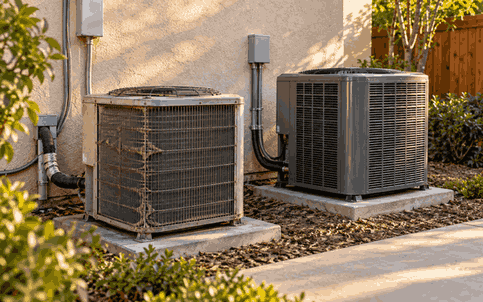
The decision to repair or replace an HVAC system should begin with a confirmed diagnosis.
Deciding whether to repair or replace an HVAC system begins with understanding what has failed and whether the remaining equipment is in serviceable condition.
An older system does not automatically require replacement, and a single breakdown does not always indicate that its useful life has ended.
The decision should consider equipment condition, repair history, heating and cooling performance, component availability, energy consumption, and property requirements.
Weak airflow, unusual noises, inadequate heating or cooling, and repeated shutdowns can result from different problems.
Some involve an isolated thermostat, contactor, fan motor, or electrical control fault. Others involve major refrigeration, heating, or mechanical components.
Professional HVAC repair and diagnostics should identify the failed component and determine whether another condition contributed to the malfunction.
A useful assessment should establish:
What component failed and how the fault was confirmed
Whether the failure is isolated or recurring
Whether compatible replacement parts are available
The condition of other major components
Whether repair can restore reliable operation
Whether airflow or electrical problems contributed to the failure
A single symptom is not proof that the entire system needs replacement.
For specific problems, review the guides on AC Not Cooling, Heater Not Working, and Thermostat Not Working.
Repair may be appropriate when the equipment remains in generally good condition and the current problem is limited to a correctable component failure.
Potentially repairable faults include problems with:
Thermostats and temperature sensors
Capacitors, contactors, or relays
Fan motors
Drainage components
Wiring and electrical connections
Compatible control components
The surrounding equipment must still be evaluated before selecting a repair.
Professional AC repair, heating repair, or thermostat repair may restore normal operation when the rest of the system remains serviceable.
Repair deserves consideration when the HVAC system:
Maintained comfortable temperatures before the breakdown
Has not experienced repeated major failures
Contains serviceable major components
Has supported replacement parts
Can return to normal operation after the confirmed fault is corrected
A single unexpected failure does not automatically mean that replacement is necessary.
Replacement becomes more relevant when several factors indicate declining overall equipment condition.
Repeated problems involving compressors, coils, motors, heat exchangers, or electronic controls may suggest wider deterioration.
The critical question is whether failures are isolated events or part of a continuing pattern.
Serious damage to a compressor, heat exchanger, or another critical component requires a broader assessment.
A furnace identified as unsafe because of combustion-related damage must remain out of operation until the problem is properly addressed.
A system that repeatedly struggles to maintain indoor comfort may no longer meet the property's requirements.
However, duct leakage, insulation problems, poor airflow, and thermostat placement can also create uneven temperatures.
Replacing HVAC equipment without correcting these conditions may leave the underlying comfort problem unresolved.
Longer operating cycles and poor cooling performance can contribute to increased electricity consumption.
However, higher consumption may also reflect weather, thermostat settings, or airflow restrictions.
The article Why Is My Electric Bill So High When the AC Is Running? explains these differences.
Energy consumption alone is not proof that replacement is necessary.
Equipment age provides useful context, but operating conditions and maintenance history matter.
Two systems of similar age may have different remaining serviceability because of runtime, installation quality, maintenance, climate exposure, and previous repairs.
An older system with one correctable fault may remain suitable for repair.
A newer system can also develop serious problems because of installation defects, electrical failures, or incompatible components.
Replacing a heating or cooling system involves more than selecting a new unit.
A professional assessment should consider:
Correct heating and cooling capacity
Ductwork and airflow
Indoor and outdoor equipment compatibility
Refrigerant and electrical requirements
Thermostat and control compatibility
Condensate drainage
Equipment location and accessibility
Applicable permits and installation requirements
Oversized equipment may cycle excessively, while undersized equipment may struggle to maintain comfort.
The existing unit's capacity does not automatically establish the correct replacement size.
Some HVAC components must also meet manufacturer requirements for refrigerant, coil compatibility, electrical characteristics, and controls.
Professional AC installation should account for these conditions.
HVAC replacement in Orange County may involve local permits, applicable California energy standards, and installation verification.
Requirements depend on the jurisdiction, property type, equipment, and scope of work.
These considerations should be identified before installation begins.
Regular AC maintenance and heating maintenance can help identify airflow restrictions, electrical wear, drainage concerns, and developing performance problems.
Maintenance cannot prevent every failure, but service records provide useful information when evaluating repair or replacement.
Sometimes. An isolated fault may be repairable when major components remain serviceable and compatible parts are available.
Not always. The answer depends on manufacturer requirements, refrigerant compatibility, equipment condition, and system configuration.
No. Performance also depends on correct sizing, airflow, ductwork, insulation, and controls.
For professional HVAC diagnostics, repair, and replacement assessments, contact Reliable Hands Appliance.
Phone: +1 (714) 338-9438
Email: [email protected]
Office Hours: Monday through Friday, 7:00 AM to 7:00 PM
Saturday: 9:00 AM to 6:00 PM
Sunday is reserved for emergency calls. Call to confirm availability.
Office: 410 Santa Maria, Irvine, CA 92606
Time Zone: Pacific Time