410 Santa Maria, Irvine, CA 92606
E-mail us: [email protected]
24 Hour Service - 7 Days a Week

A washing machine may stop spinning because of drainage problems, an unbalanced load, door or lid lock faults, drive issues, or control problems. Learn what to check and when professional diagnosis may be needed.
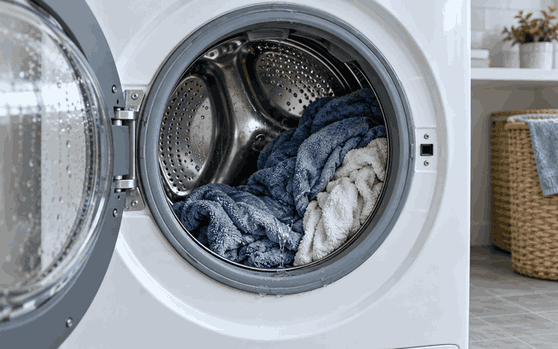
My Washing Machine Not Spinning
A washing machine that is not spinning may have an unbalanced load, incorrect cycle setting, drainage restriction, defective door lock, worn drive components, or an electronic control problem.
Before assuming the motor has failed, check whether the washer has drained and whether the selected program includes a normal spin cycle. If water remains inside, our guide to washing machines not draining explains the related causes.
Heavy towels, blankets, and tangled clothing can collect on one side of the drum. Modern washers may reduce spin speed or stop to prevent excessive movement.
Overloading restricts drum movement, while very small loads can also become difficult to balance.
Wait for the drum to stop and the door to unlock before redistributing laundry. Follow the manufacturer's loading recommendations.
Delicate, hand-wash, and specialty cycles may use reduced spin speeds or disable spinning.
Check the selected program, spin-speed setting, and any Rinse Hold option before assuming the appliance has a mechanical fault.
Many washers will not begin high-speed spinning until the drainage stage finishes.
A blocked pump filter, kinked drain hose, defective pump, or drainage-control fault may leave water inside the tub.
Check for standing water and unusual pump noises. Drainage problems should be investigated before replacing drive components.
Washing machines use safety interlocks to confirm that the door or lid is secured.
A damaged latch, defective switch, wiring fault, or electronic lock problem may interrupt spinning even when the door appears closed.
Never bypass a safety interlock to force the washer into operation.
Depending on the model, a washer may use a belt, coupling, clutch, rotor, stator, or another drive assembly.
A worn component can prevent the drum from reaching normal speed. Warning signs include unusual motor noises, inconsistent rotation, or a burning odor.
Damaged shock absorbers, suspension rods, springs, or bearings may cause excessive shaking and automatic spin interruption.
Stop using a machine that moves violently or strikes its cabinet.
A failed motor component, speed sensor, inverter, wiring connection, or control board may prevent the final spin.
These faults require model-specific electrical diagnosis rather than repeated resets or unnecessary part replacement.
Modern washers may display warnings involving drainage, load balance, door locking, or motor operation.
Common examples on compatible models include:
LG: OE indicates a drainage problem, UE relates to load imbalance, and LE concerns motor operation. See the LG Error Codes Guide.
Samsung: 5C/5E indicates drainage trouble, while dC/dE concerns the door or lid. Review Samsung Error Codes.
Whirlpool: F9 E1 identifies a long-drain condition, F7 E1 concerns motor-speed sensing, and F5 E2 may involve door locking. See Whirlpool Error Codes.
Bosch: E16/F16 relates to door operation, while E80 may indicate a drive-circuit problem on certain models. Review Bosch Error Codes.
Miele: F11 indicates a drainage fault that may prevent the final spin. See Miele Error Codes.
Codes vary by model. Record the complete warning, appliance model, and stage where the cycle stops. An error code does not automatically identify a failed component.
Before requesting professional assistance:
Confirm that water has drained.
Redistribute heavy or tangled clothing after the drum stops.
Remove excess laundry from an overloaded machine.
Check the cycle and spin-speed settings.
Make sure the door or lid closes correctly.
Note unusual noises, vibration, and displayed codes.
Do not force a locked door, bypass safety switches, or inspect energized electrical components.
Stop using the washer if it leaks near electrical connections, produces smoke or a burning odor, or repeatedly trips a breaker.
Excessively wet laundry may result from low spin speed, uneven loading, incomplete drainage, excess detergent suds, or drive-system problems.
Heavy fabrics naturally retain more moisture, but everyday clothing should not consistently emerge saturated.
If the washer spins correctly and the dryer still struggles, our article about a dryer that runs without heating explains separate heating and airflow problems.
Professional washing machine repair is appropriate when the appliance drains but will not spin, repeatedly displays errors, shakes excessively, or produces unusual mechanical noises.
A technician can evaluate drainage, drive components, suspension, door locks, sensors, motors, and electronic controls to identify the underlying failure.
Yes. Excessive suds can interfere with water-level sensing, drainage, and spin performance, especially in high-efficiency washers.
The additional load may expose balance, suspension, drive, or motor-performance problems that are not obvious during an empty cycle.
No. Stop using it until the cause is identified. Excessive movement can damage hoses, suspension components, wiring, and surrounding surfaces.
For professional washing machine spin diagnostics and repair, contact Reliable Hands Appliance.
Phone: +1 (714) 338-9438
Email: [email protected]
Office Hours: Monday through Friday, 7:00 AM to 7:00 PM
Saturday: 9:00 AM to 6:00 PM
Sunday is reserved for emergency calls. Call to confirm availability.
Office: 410 Santa Maria, Irvine, CA 92606
Time Zone: Pacific Time