410 Santa Maria, Irvine, CA 92606
E-mail us: [email protected]
24 Hour Service - 7 Days a Week

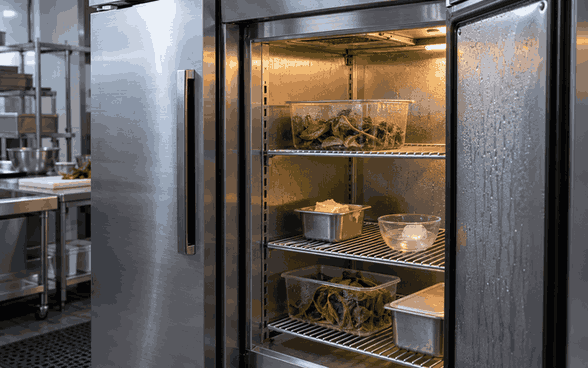
A commercial refrigerator that is not cooling may have blocked airflow, a dirty condenser, damaged door gasket, failed fan, evaporator icing, faulty control, compressor problem, or sealed-system failure. In a restaurant, hotel, market, or managed facility, rising temperature is more than an equipment problem because it can place stored inventory and normal operations at risk.
A commercial refrigerator that is not cooling properly can disrupt restaurant operations, compromise food storage, and put temperature-sensitive inventory at risk. Common causes include dirty condenser coils, blocked airflow, damaged door gaskets, faulty fans, defrost problems, temperature sensors, and compressor or refrigeration-system failures.
Before assuming a major component has failed, check the actual temperature, observe the equipment's behavior, and identify any displayed alarms.
When commercial refrigeration loses cooling capacity, food safety must come first.
The FDA Food Code 2026 identifies 41°F (5°C) or below as the general cold-holding standard for applicable time/temperature control for safety foods, subject to specified exceptions.
Measure and document representative product temperatures, not just the temperature displayed on the cabinet controller.
Minimize unnecessary door openings and transfer affected inventory to verified working refrigeration when required by your facility's food-safety procedures and applicable regulations.
Do not assume products remain safe simply because the refrigerator still feels cool.
Commercial kitchens generate grease, dust, and airborne debris that can accumulate around condenser surfaces.
A dirty condenser reduces heat rejection and may cause longer compressor cycles, poor temperature recovery, and insufficient cooling.
Inspect accessible condenser grilles for visible contamination. Internal cleaning should follow manufacturer instructions.
Commercial refrigerators require consistent airflow around stored products.
Overloaded shelves, containers positioned against air vents, or tightly packed ingredients may create warm areas inside the cabinet.
Keep designated supply and return air passages unobstructed.
Worn door gaskets, damaged hinges, and improperly closing doors allow warm air and moisture to enter.
This increases refrigeration demand and can contribute to frost buildup, condensation, and unstable cabinet temperatures.
Check whether doors close fully and inspect visible seals for gaps or damage.
A malfunctioning evaporator fan can prevent cold air from circulating properly.
On applicable systems, condenser fan failure can interfere with heat removal.
Defrost problems may allow excessive ice to accumulate around the evaporator, while defective temperature sensors can interfere with accurate control.
Recurring frost, uneven temperatures, and unusual fan noises require further diagnosis.
A refrigerator that runs continuously without reaching its selected temperature may have an electrical, compressor, or sealed refrigeration-system problem.
However, similar symptoms can result from dirty coils, faulty fans, or excessive heat entering the cabinet.
Compressor and refrigerant-system faults require professional testing, not repeated controller resets or unnecessary refrigerant additions.
Many commercial refrigerators display warnings when cabinet temperatures, condenser conditions, sensors, or compressor operation become abnormal.
These examples apply only to compatible models and controllers:
True Refrigeration: HI indicates excessive cabinet temperature, Con concerns condenser conditions, and LEA relates to extended compressor operation. Review the True Commercial Refrigeration Error Codes Guide.
Traulsen: cHI or HI CAB indicates high cabinet temperature, CLn FL concerns condenser or filter conditions, and DEF Err relates to defrost performance. See Traulsen Commercial Refrigeration Error Codes.
Beverage-Air: Hi indicates a high-temperature condition, Con concerns condenser temperature, and LEA signals extended compressor runtime on supported controllers. Read the Beverage-Air Error Codes Guide.
Avantco: HI indicates excessive cabinet temperature, CHt concerns high condenser temperature, and rSF identifies a refrigeration-system failure condition. Consult the Avantco Commercial Error Codes Guide.
Hoshizaki: On compatible RR/RF reach-ins, E1 indicates high temperature and E7 indicates condenser-filter attention. See Hoshizaki Commercial Appliance Error Codes.
Important: An error code identifies a detected condition, not necessarily the failed component. Record the complete code and equipment model before resetting the controller.
Facility personnel can perform basic observations without accessing electrical or refrigeration components.
Confirm the selected temperature and operating mode. Check whether doors close securely, inspect accessible gaskets, and reposition inventory that blocks airflow.
Look for visible debris around condenser grilles and record cabinet temperature, product temperature, frost accumulation, unusual noises, and active alarms.
Do not remove energized panels, puncture evaporator ice, bypass safety devices, or open refrigerant connections.
If water reaches electrical components or the equipment repeatedly trips a circuit breaker, stop using it and request qualified assistance.
Professional commercial refrigerator repair is appropriate when temperatures remain unstable, the compressor repeatedly starts and stops, airflow is insufficient, or error codes continue returning.
A technician can evaluate fans, door seals, sensors, condenser performance, defrost components, electrical controls, and refrigeration operation.
Provide the business address, equipment type, brand, model and serial numbers, temperature readings, alarm messages, and the approximate time the problem began.
Uneven temperatures may involve blocked airflow, loading practices, fan problems, or evaporator icing. Check product placement and record temperatures at different locations before diagnosis.
Yes. Poor heat rejection can reduce cooling performance and extend compressor runtime. However, door leakage, excessive loading, sensor problems, and refrigeration faults can produce similar symptoms.
Commercial freezers have different temperature and defrost requirements. Review Why Is My Commercial Freezer Not Freezing? for equipment-specific troubleshooting guidance.
Regularly inspect door gaskets, maintain suitable product loading, follow manufacturer-approved cleaning procedures, and document temperatures and recurring alarms.
The Commercial Appliance Preventive Maintenance Checklist provides additional guidance for managing commercial equipment.
For professional commercial refrigerator cooling diagnostics and repair, contact Reliable Hands Appliance.
Phone: +1 (714) 338-9438
Email: [email protected]
Office Hours: Monday through Friday, 7:00 AM to 7:00 PM
Saturday: 9:00 AM to 6:00 PM
Sunday is reserved for emergency calls. Call to confirm availability.
Office: 410 Santa Maria, Irvine, CA 92606
Time Zone: Pacific Time